BREAKING NEWS

Pakistan Today

Gossips

Politics

From our Blog

Showing posts with label Politics. Show all posts

Monday, August 24, 2015

No talks with India without Kashmir on agenda: Aziz

The prime minister’s adviser of national security and foreign affairs Sartaj Aziz once again clarified on Monday that there could be no talks with India without Kashmir on the agenda.
Days after the scheduled NSA-level talks between the two countries collapsed, Aziz categorically rejected the perception that Pakistan’s armed forces were not willing to open dialogue between the two arch-rivals.
“There is no difference between the Pakistan Army and the political leadership. As far as Kashmir is concerned not only the political leadership, the whole nation is united that we cannot talk to India without Kashmir,” said Aziz while exclusively talking to CNN-IBN. 
The meeting was agreed upon by the prime ministers of the two countries in their meeting on the sidelines of the Shanghai Cooperation Organisation in the Russian city of Ufa last month.
When asked if he would propose a meeting between NSA advisers of the two countries at the UN General Assembly session in New York, he said, “We are not going to propose that, but if India proposes then we’ll see.”
Aziz said he will exchange the dossiers of Indian spy agency RAW’s involvement with Pakistan, even if he doesn’t get a chance for a meeting with Ajit Dowal, the Indian national security adviser.
Despite the talks being called off, the NSA adviser said the meeting between the DGMOs and the DG BSF and Pakistan Rangers will go ahead.
“The BSF meeting is confirmed for September 6, and they have already had a preliminary meeting to discuss the agenda,” he said. “DGMO talks happen every week anyway and they can agree among themselves whenever they want to meet.”
No evidence shared with Pakistan
Meanwhile, Aziz denied Pakistan had been provided any evidence on the presence of Dawood Ibrahim in the country, or the country’s involvement in Gurdaspur attacks.
“What co-operation? I mean they, let them provide. On Gurdaspur nothing has been provided. If they provide – we will take action,” he said. “India is always using the media to target and point fingers at Pakistan without providing anything. In my two years, I have not seen any evidence being provided on these two issues.”
Last month, gunmen dressed in military fatigues killed at least 10 people, including three civilians, in India’s Punjab state before being shot dead in a 12-hour-long gunfight with security forces in a small-town police station near the border with Pakistan.

PTI to approach Supreme Judicial Council against ECP members

A month after a judicial commission formed to probe alleged rigging in 2013 general elections published its report highlighting some lapses on part of Election Commission of Pakistan (ECP), Pakistan Tehreek-e- Insaf (PTI) is considering moving the Supreme Judicial Council for the removal of four members of ECP from four provinces.
PTI senior leader Ishaq Khan Khakwani, who was chairman task force constituted to plead the PTI’s case in front of an inquiry commission, has sent a written proposal to party chief Imran Khan stating that four members of the poll body were in part responsible for not holding the 2013 general elections as per law.
The proposal contended that the judicial inquiry into the 2013 elections “held ECP responsible for many legal lapses (40 in all). These lapses made the entire election 2013 non-transparent and unlawful.”
Further, it claimed that the incumbent Chief Election Commissioner Justice Sardar Raza is facing opposition from four other commission members in responding to Imran Khan’s July 30 letter.
“No response from the Election Commission is therefore understandable but this state of affairs from a constitutional body is unacceptable for anyone in the general public and least of all from PTI who is the second largest party in whole of Pakistan,” the proposal reads.
Imran Khan, in a six-page letter to ECP chief Sardar Raza, had asked the commission to take action against those responsible for failures, breaches, and ‘illegalities’ in 2013 general elections.
While recommending that PTI should take to the streets against the alleged rigging, Khakwani said on legal front the party should consider moving Supreme Judicial Council against ECP members.
“Besides the agitation the legal recourse which may be considered is to move the Supreme Judicial Council as per Article 209 of the Constitution to try the 4 members of the Election Commission for their misconduct and willful complacency in not holding the general elections in the manner as defined in law”, he added.
Sources told The Express Tribune the PTI chairman has already started consultations over the proposal for filing a reference against ECP members.
However, PTI’s top brass is divided over the filing of reference as one section believes that in view of the past judicial history, it’s impossible that SJC will give verdict against fellow retired judges, who are presently performing the duty as ECP members. Meanwhile, another section within the party believes that there is no harm in filing a reference.
Earlier, senior vice president PTI legal wing Punjab in his individual capacity has submitted a reference regarding the removal of ECP members.
The development comes a day after PTI chief Imran Khan warned that his party will stage another sit-in outside the Election Commission of Pakistan (ECP) if the poll body fails to respond to his July 30 letter.
In view of Article 209 of the Constitution, the SJC comprises the chief justice of Pakistan (CJP), two senior most judges of the Supreme Court, and two most senior chief justices of high courts.
The main function of the council is to hear complaints against superior court judges, as well as other top government functionaries such as the NAB chairman, Election Commission of Pakistan’ s members, AGP etc. The proceedings of the SJC remain in-camera, whereas the SC registrar performs the function of secretary to the Council.

Saturday, August 22, 2015

Iran shot down unknown surveillance drone on western border-state news agency

Iran recently shot down an unknown surveillance drone on its western border, the state news agency said on Saturday.
“After spotting the drone, our air defence system missiles shot it down,” Farzad Fereidouni, commander of Anti-aircraft system in Kermanshah province was quoted as saying by IRNA.
“We have given warning to 12 unknown flights last year and they have left Iran’s air space.” He did not mention which country the shot-down drone belonged to.
Fereidouni added, “The drone which was shot down in Kermanshah province was of reconnaissance type.”
Iran has brought down US surveillance and what it claims to be Israeli drones in recent years.
In August last year, Iran’s elite Revolutionary Guard claimed it had brought down an Israeli stealth drone above the Natanz uranium enrichment site in the centre of the country.
“A spy drone of the Zionist regime (Israel) was brought down by a missile… This stealth drone was trying to approach the Natanz nuclear zone,” the corps said in a statement on its official website sepahnews.com.
“This act demonstrates a new adventurism by the Zionist regime… The Revolutionary Guard and the other armed forces reserve the right to respond to this act,” the statement added.

Abbas quits PLO leadership ahead of internal election: Official

Palestinian president Mahmud Abbas resigned Saturday as head of the Palestine Liberation Organisation’s Executive Committee in a bid to force new elections for the top body, an official said.
Wassel Abu Yussef said that more than half of the 18-member committee had also stepped down.
“The resignation of the president of the executive committee Mahmud Abbas and more than half of its members has created a legal vacuum, and therefore the Palestine National Council has been asked to meet in one month to elect a new executive committee,” Yussef told AFP.
The executive committee is the PLO’s highest decision-making body and acts on behalf of Palestinians in the occupied territories and the diaspora, namely in the peace process with Israel.
In 1993, Abbas, then executive committee secretary general, signed the Oslo autonomy accords on behalf of the Palestinians.
Yussef said that before the resignations were announced, the executive committee elected chief Palestinian negotiator Saeb Erakat as its secretary general.
That move came after Abbas suspended another key member, Yasser Abed Rabbo, as secretary general.
It was not immediately clear why Abed Rabbo, a veteran PLO figure, had been sidelined.

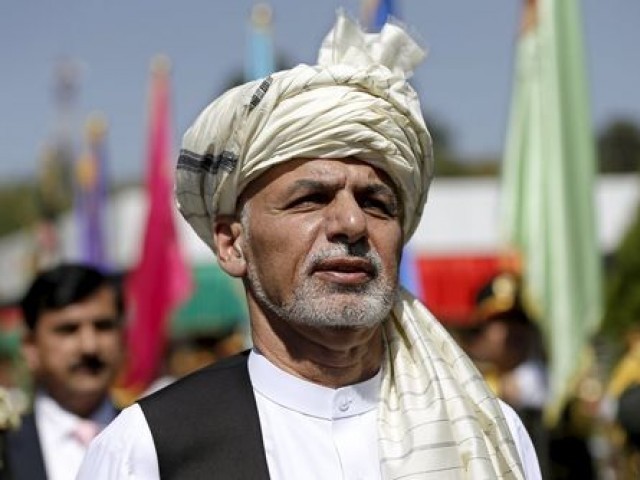
Ghani to urges Pakistan to use same definition of terrorism for Afghanistan as it does domestically

On a day when a car bomb killed 12 people in Kabul, Afghan President Ashraf Ghani reiterated his call on Pakistan to adopt the “same definition” for terrorism for attacks in Afghanistan as it does for attacks across the Durand Line.
“Pakistan should have an understanding of the situation in Afghanistan and use the same definition of terrorism with regards to Afghanistan as it does domestically,” Ghani said in a meeting with outgoing Swedish Ambassador to Afghanistan Peter Semneby.
In a statement released from the Afghan Presidential Palace, Ghani added that the region and the world are in agreement with Afghanistan on the fight against terrorism, especially on the links between terrorism and criminal economy.
President Ghani, while touching on the recent developments within the country, said that peace talks (with Taliban) would proceed within an Afghan-owned and Afghan-led process.
Talks with the Taliban had stalled after it emerged that the group’s obscure supremo Mullah Omar had died two years ago. The news caused ripples, especially within the Taliban who faced a split over electing a new leader. Pakistan said there had been progress in the first ever talks between the representatives of the Afghan government and the militants in Murree on July 7.
However, the Afghan government now says it wants to lead the reconciliation process without the involvement of any other country. But the Taliban have ruled out direct talks with the Kabul.
“We are in a sensitive situation, but we move on the right direction and that we have the people of Afghanistan with us,” Ghani told the Swedish ambassador.
Pakistan condemns Kabul attack
Pakistan condemned the suicide attack that took place near a hospital in Kabul on Saturday.
“We standby with our brotherly people of Afghanistan in this moment of grief and convey our deepest condolences to the bereaved families. We pray to Almighty Allah to grant them patience and forbearance in this hour of difficulty and hope for the speedy recovery of the injured,” a statement read.
It said that the attack targeting civilians reflected the cowardice of terrorists. “It strengthens our resolve to continue our struggle of countering terrorism in all of its forms. We reiterate our resolve to closely coordinate with the Government of Afghanistan in this fight against our common enemy.”

Friday, August 21, 2015

Rejecting preconditions: India going back on mutually decided NSA talks, says FO


With the national security level talks between Pakistan and India hang by a thread after Pakistan rejected India’s move to precondition the talks over a meeting between Hurriyat leaders and Adviser to the Prime Minister on Foreign Affairs and National Security Sartaj Aziz, the foreign office said that India was trying to scupper the talks.
“It is not Pakistan that has placed any condition for the talks. In fact, Pakistan has always demonstrated its belief in the dialogue process and is prepared to engage in meaningful talks with India, to resolve all outstanding issues that have bedeviled relations between the two countries, for the past many decades,” read a statement from Ministry of Foreign Affairs spokesperson Qazi Khalilullah, adding that Pakistan was deeply disappointed over the statement from spokesperson of India’s Ministry of External Affairs which put pre-conditions on the talks.
In a statement issued on Friday evening, the foreign office said that escalating tensions along the border in recent talks weeks made sincere and serious dialogue the need of the hour to immediately reduce tensions and required both countries to undertake the task of normalisation of relations, with sincerity and seriousness.
“This is the second time that India has chosen to go back on a decision mutually agreed upon between the two Prime Ministers, to engage in a comprehensive dialogue, by coming up with frivolous pretexts.”
Defending Pakistan High Commissioner’s invitation to Kashmiri Hurriyat leadership to a reception in honour of Aziz on August 23, Khalilullah said that it was a move very much in keeping with the practice and tradition of the past many years. “Pakistan sees no reason to depart from this established practice. After all, the Kashmiri Hurriyat leaders are genuine stakeholders in efforts to find a lasting solution of the Kashmir dispute.”
“For India to refuse to engage in talks with Pakistan on this pretext is a repeat of what it did when it cancelled the foreign secretary level talks that were scheduled to be held on August 25 last year, pursuant to the meeting between the two Prime Ministers in Delhi in May 2014.”
In a veiled reference to the stance adopted by Indian home minister Rajnath Singh that talks should be held only on terrorism, the foreign office spokesperson said that Pakistan had proposed a comprehensive agenda for the talks.
“Consistent with the decisions taken by the two Prime Ministers in Ufa, [agenda] which included discussion on all outstanding issues, including Kashmir, as well as terrorism related matters, and other issues such as religious tourism, release of fishermen and peace and tranquility on the LoC. However, regrettably, the Indian side’s desire to restrict the agenda to terrorism related issues only, amounts to a negation of the decisions taken by the two Prime Ministers.”
Pakistan, the statement said, does not disregard agreements or understandings. It is the Indian side which has reneged on commitments agreed upon between the two Heads of Government in the past year.
“Pakistan wishes to reiterate its abiding commitment to promoting a relationship of cordiality and cooperation with all its neighbours, including India, in pursuance of the Prime Minister’s vision of a peaceful neighbourhood.”

Mansoor seeks time to settle Taliban head row


 The new supreme leader of the Afghan Taliban, Mullah Akhtar Mansoor, has sought more time to empower a panel of religious scholars to take a decision over his controversial appointment.
Mansoor was elected as the chief of the Taliban soon after the death of his predecessor, Mullah Omar, was officially confirmed on July 31. But some senior Taliban leaders and the family of Mullah Omar refused to recognise him as the new supreme leader of the group.
The row prompted Afghan religious scholars to form a committee to mediate between Mansoor and his supporters, and the opponents of his election in order to heal the rift within the militia.
Last week, Maulvi Ahmed, the head of panel, told The Daily Dera that all sides save for Mansoor’s had empowered them to take any decision over the matter.
The panel met Mansoor on Thursday but failed to obtain on assurance that he would accept the scholars’ decision.
“Akhtar Mansoor, who received the ulema early Thursday, sought some more time to apprise the members of the [Taliban] leadership council and his other aides before taking any decision,” a member of the scholars’ committee told The Daily Dera on Thursday. Due to this, the scholars, who had planned to announce a decision on Wednesday, have delayed their verdict, he said.
However, Mansoor Dadullah, one of Mansoor’s opponents, urged the panel of scholars to not delay their decision. “Prolonging the differences can lead to Taliban infighting,” he said. “We want the Taliban to respect the ulema’s [scholars] decision.”
According to some sources, Dadullah is throwing his weight behind Mullah Omar’s son Mullah Yaqoob for the new Taliban chief’s slot.
Other sources, meanwhile, said Mansoor has strengthened his position over the past few weeks as many Taliban shadow governors and commanders in the north and east of Afghanistan had sworn allegiance to him.

Civil-military leadership rejects New Delhi stance


The civil and military leadership on Friday decided not to accept the Indian demand to keep the proposed national security advisers (NSA) meeting in New Delhi limited to the issue of terrorism and resolved that the talks should include all bilateral disputes, including that of Kashmir.
According to the PM House, Prime Minister Nawaz Sharif held a high-level meeting to review the security situation in the country. The meeting also deliberated various aspects of internal security and discussed implementation of the National Action Plan, the statement said.
The meeting was attended by army chief General Raheel Sharif, Finance Minister Ishaq Dar, Interior Minister Chaudhry Nisar Ali Khan, Punjab Chief Minister Shahbaz Sharif, Adviser to PM on National Security and Foreign Affairs Sartaj Aziz, and Special Assistant to the PM on Foreign Affairs Tariq Fatemi.
According to sources, the leaders discussed India’s proposed agenda for the NSA meeting. In the agenda, India has advised Sartaj Aziz not to meet Kashmiri Hurriyat leaders and to remain focused on terror related issues.
Read: Regional Security: EU special rep lauds army sacrifices
The civil and military leadership resolved not to fall into the Indian trap to discuss only the issue of terrorism but said Islamabad should also broach all bilateral international disputes with New Delhi. They reiterated that Pakistan should adopt an aggressive approach with India on terrorism related issues and a give-and-take policy on international disputes.
The participants said India’s offensive approach towards Pakistan could only be countered by Pakistan’s aggressive approach on terrorism related issues as it could break the Indian mantra on terrorism and help pave way for talks on bilateral disputes.
It was agreed that Pakistan would take up all bilateral disputes including Kahsmir, Sir Creek and Siachen. It was decided that Pakistan will take up the issue of release of the Samjhota Express incident’s alleged mastermind to counter-balance the release of Mumbai attacks alleged mastermind, Zakiur Rehman.
The participants also agreed to highlight Indian involvement in Balcohsitan to counter Indian allegations of Pakistani involvement in the recent Gurdaspsur incident.
The participants also discussed India’s new offensive and its maneuvering in the region to form a new regional South Asian Association for Regional Cooperation (Saarc) by excluding Pakistan. The new regional Saarc will work under the main Saarc but will not include Pakistan.
Sources said Bangladesh, Nepal, Bhutan and even Iran are with India and they might announce it soon.  In view of the developing situation, the civil military leadership devised various options to counter the move.
Afghanistan peace talks
Sources said the civil and military leadership also discussed Afghan issue in detail. They noted that Pakistan is willing to help resume talks between Afghan Taliban and Afghan government but the Afghan government is not serious in talks particularly after the death of the Afghan Taliban supreme leader Mullah Muhammad Omar.
They also observed that the Taliban have intensified their attacks against Afghan government due to their internal rift and to reassert their power of resistance.
Operation in Shawal Valley
The civil and military leaders agreed that the initiation of ground offensive in Shawal Valley would satisfy the Afghan government which blames Pakistan for not taking action against Afghan Taliban sheltering in Pakistan.
Read: South China Sea tensions flare at Asia security talks
The military leadership informed civilian leadership that Shawal ground offensive is not the final phase of operation Zarb-e-Azb but the operation will continue against all types of terrorism.
Security in Punjab, Karachi
Punjab Chief Minister Shahbaz Sharif briefed the participants about security situation in Punjab in the wake of the killing of Punjab home minister Col (retd) Shuja Khanzada and vowed that all sectarian culprits will be apprehended.

Disgruntled MQM breaks off negotiations with govt, wants resignations to be accepted


Angry at the cold shoulder treatment meted out to it during Prime Minister Nawaz Sharif’s latest visit to the megalopolis and the continued action against its members, the Muttahida Qaumi Movement (MQM) demanded that its resignations from the Senate, National Assembly and the Sindh Assembly, should be accepted, breaking off negotiations with the government.
According to a statement released early on Saturday morning, the party – after a joint meeting between the party’s Rabita Committee in London and Karachi – lamented the ‘threatening’ attitude of Nawaz during his visit to Karachi on Thursday.
They said that the government-appointed mediator Mualana Fazlur Rehman and the MQM had a successful meeting just a few days earlier where it was decided to continue talks in Islamabad. But, Nawaz’s attitude during his meeting at Governor House on Thursday disrespected Rehman’s role.
The party lamented how the prime minister did not even utter a word about the meeting or that the government wanted to solve genuine grievances of MQM. Nor did the prime minister visit the injured Rashid Godil, a member of the same National Assembly that Nawaz is a part of.
While leaving the door open for Rehman to hold talks with MQM at any point, the party said that they will no longer discuss a return to assemblies with him.
Instead of focusing on a return to parliament, the party said they had unanimously decided to divert their energies towards their social welfare work under the Khidmat-e-Khalq Foundation and for creating a new province.

Obama lays out case for Iran nuclear deal in letter to Congress


U.S. President Barack Obama laid out his case for lawmakers to back the nuclear deal with Iran in a letter released by the White House, the latest step by the administration to gain support for a deal critical to the president's legacy.
In an Aug. 19 letter to Representative Jerrold Nadler, a Democrat from New York, Obama spelled out arguments he has made repeatedly in recent weeks: that the deal with Tehran was a good one, that Washington was enhancing its security cooperation with Israel, and that the United States would maintain its ability to punish Iran for destabilizing activities in the Middle East.
"Should Iran seek to dash toward a nuclear weapon, all of the options available to the United States - including the military option - will remain available through the life of the deal and beyond," Obama wrote.
The White House is seeking support from Democrats in Congress for the deal to give Obama backing to sustain a veto if Republicans and some Democrats reject it as expected.
"The President and senior members of his team have been in regular consultation with Members of Congress, including Representative Nadler, to ensure they have the information they need to judge the deal on its merits," a White House official said. "The letter reaffirms the Administration's stalwart commitment to our regional allies, chiefly Israel."
Obama is currently on vacation on the Massachusetts island of Martha's Vineyard. He and his staff have been pressing Democrats in Congress for their support for weeks.
 
Copyright © 2015 The Daily Dera | Designed By Ziaullah Mehsood
Powered by King Empire Corp